Key Takeaways
- SEO can help ensure search visibility, and AI-assisted search experiences can be enhanced by AEO and GEO.
- As SEO continues to drive consistent traffic to your financial services company’s site, AEO and GEO tactics are increasingly determining whether the leading AI chat tools (ChatGPT, Gemini, Perplexity) mention your brand name or not.
- The strongest fintech plans incorporate all of the above and often partner with a generative engine optimization or geo-marketing agency that can help run the AI layer of your fintech plans.
Introduction
A very interesting fintech founder scenario: the founder checks her online visibility by searching for her company name on Google. She’s on page one, position three. She gets steady traffic. Later, the very same founder types a question that her customers would typically type into Google into the input field of her preferred AI chat tool (e.g., ChatGPT, Gemini, Perplexity). To her shock and amazement, her brand name is completely absent from the output. And this is a huge problem for fintech companies today.
What Is SEO, really?
SEO is the process of getting a fintech company’s website to rank on Google for terms that customers search for, such as “best savings accounts for freelancers” or “how to send money abroad without fees”.
Good organic SEO services include a number of different elements, including website structural fixes, keyword research, and long-form, answer-the-question-based content. While for fintech, SEO still holds the most weight due to its measurable nature and ability to compound over time and get converted to tangible leads with a source that can be tracked, it does not guarantee that your brand will appear when asking AI for the same question as humans.
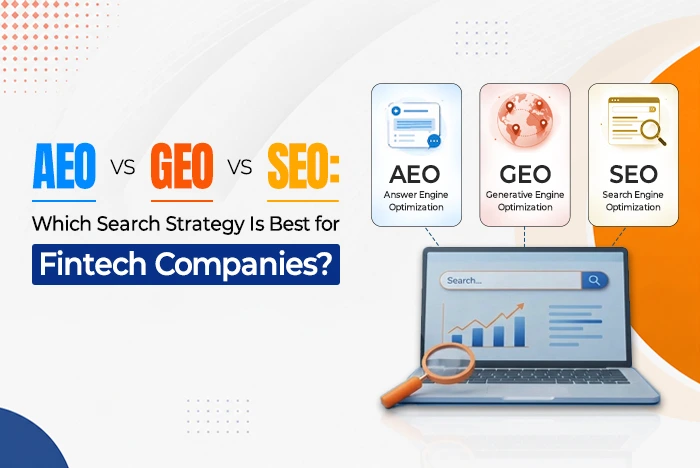
What Is AEO (Answer Engine Optimization)?
The end goal of AEO (Answer Engine Optimization) is to have your content serve up as the direct answer to search queries in the form of a Google featured snippet, an AI Overview summary, or voice assistant read-out. The primary goal here is to express your answer in a single, concise sentence followed by an explanation of said answer.
Many fintech companies that invest in AEO (answer engine optimization) services start by reorganizing their existing blog content into short, direct answers under each subheading. Try to make sure all definitions and descriptions are crystal clear, and that FAQ sections are written from real customer questions as opposed to guessing what users might want to know.
What Is GEO (Generative Engine Optimization)?
GEO is a relatively new discipline to AEO and refers to how companies can get themselves included in the actual answer that an AI tool such as Claude or Perplexity generates. So, in the example of someone comparing business checking accounts, the work of GEO is to get your brand included in the answer to their question.
A solid GEO agency can help, since GEO is new for a lot of SEO teams. They work on making sure your brand details stay the same across the web. They also sort and label your information, so it is easy to follow. On top of that, they help you publish content that AI systems can read and use.
SEO vs AEO vs GEO at a Glance
| SEO | AEO | GEO | |
| Goal | Rank in Google | Get picked as the direct answer | Get named inside AI-generated answers |
| Where it shows up | Google search results | Featured snippets, AI Overviews | ChatGPT, Claude, Perplexity, Gemini |
| Main tactics | Keywords, backlinks, technical fixes | Short direct answers, FAQ schema | Entity consistency, citable data, clean structure |
| Typical timeline | Months | Weeks | Weeks to a few months |
Why Fintech Needs a Different Playbook?
Content related to fintech belongs to the so-called “Your Money or Your Life” category of Google Search. As a result, such content requires the highest standards of accuracy, author credibility, as well as real names. Blog posts about crypto taxes and lending offer low value in terms of SEO if they are not verifiably accurate, contain no referenced sources, and are unlikely to get cited by AI-powered search engines seeking to provide users with the best possible financial information and avoid the spread of potentially inaccurate financial advice.
Generative search engines often rely on the very same sources that we trust: government and regulatory bodies, established financial news publications, and well-researched online content. And when it comes to setting out the standards for online financial information, authority is key. Will your bloggers and contributing writers have clearly written, hyperlinked credits for their work? Will your content be reviewed by an expert?
Another interesting stat to keep an eye on is that 68% of US Google searches have ended without a click in the first 4 months of 2026, compared to 60% in 2024 (SparkToro + Similarweb data). As this form of research becomes more prevalent, the fintech buyer will increasingly be consuming information in these spaces.
Which Strategy Should Fintech Companies Prioritize?
Don’t pick just one. A fintech buyer will often Google something and then open an AI chat tool to dig deeper, sometimes within minutes of each other. In the meantime, it’s pretty clear that a Fintech buyer will Google search for something and then go to an AI chat to read more around the topic within the same research session – sometimes within minutes of each other.
organic SEO services: for now, this remains the biggest and most traceable channel. We recommend that you establish a solid SEO foundation first and then proceed to AEO and GEO.
Layer AEO onto your current high-performing pages. Rewrite the first two sentences under each subheading as direct answers to the questions posed. Create an FAQ section consisting of answers to frequently asked questions that have come up through your support team and/or sales calls.
Finally, visibility in AI search needs to be checked from time to time – not set up once and forgotten. Use ChatGPT, Claude and Perplexity to test out the questions and topics that your customers would search for and note who is citing who. If it isn’t you, then that is a content gap that needs to be closed.
A Simple Way to Combine All Three
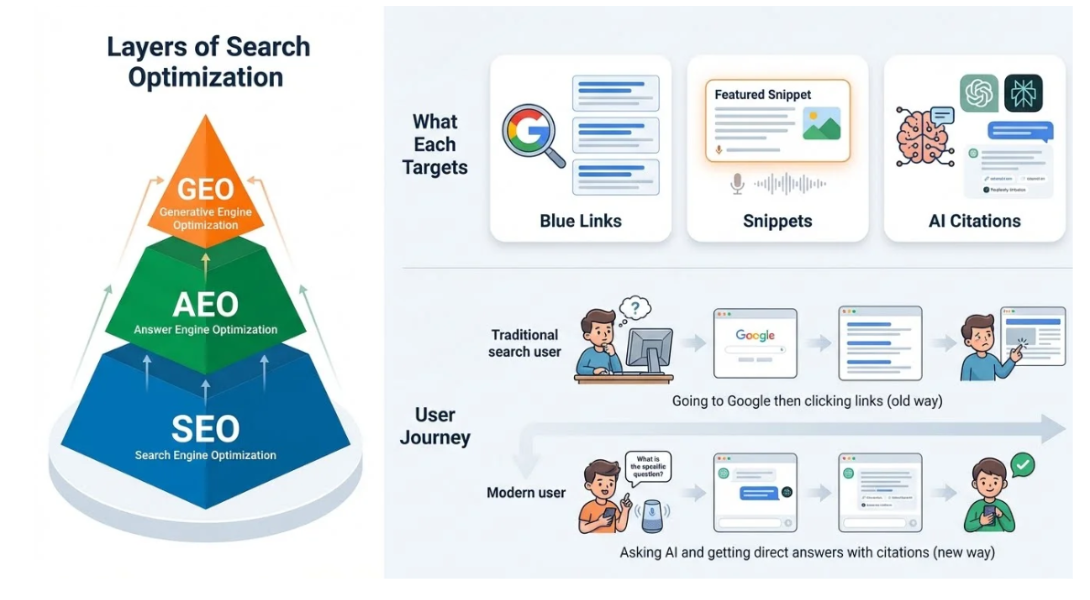
One model many fintech marketing teams use is to start with your SEO and build out your AEO and GEO from your existing content. So, SEO is the foundation of your content, AEO is the format of your content, and GEO is the reach of your content.
First, build the foundation for your organic SEO services (SEO) and create your AEO content on top of that. Then create GEO-based content that builds your trust signals, including your author bios, sourced data, and consistent brand descriptions across all online sources where your brand is mentioned.
However, many fintech companies have the requisite in-house expertise to create high-quality content and optimize it for search. In such cases, they can have the same team that handles their organic SEO services and also implement AEO and GEO. For other companies, however, it makes sense to bring in an outside expert who can create an AEO and GEO strategy and implement it quickly.
The Bottom Line
You should think of SEO, AEO, and GEO as three scoreboards to measure the progress of your fintech brand on its journey through the digital landscape. By keeping strong points for SEO, good content optimized for direct answers, and a consistent brand description in all sources an AI tool uses, you can ensure that customers find you in both Google search results and in chats with tools like ChatGPT or Gemini.
To start, audit your top content and start from there to optimize visibility. Don’t wait for a slow traffic quarter to start. Waiting just means playing catch-up later, often with a generative engine optimization geo marketing agency brought in to close the gap fast.