Key Takeaways
- White label SEO allows agencies to resell expert work as their own product while not employing a full team of in-house SEO staff.
- In-house SEO means your own team does the work. You get full control, but salaries and tools add to your costs.
- Studies report that nearly 73% of online marketing firms now rely on the services of a skilled search engine optimization team rather than maintaining their own full-time in-house SEO team.
Introduction
You have two choices as your agency grows: either build out a full SEO team and start taking on clients as quickly as they come in, or you outsource the work of your in-house SEO and resell it to your clients under your own brand.
Each option has the potential to bring in massive profits for your agency, but each option also has the potential to drain you of all your profits as you overpay a team of underutilized, idle employees. Read on to find out what white label SEO and in-house SEO are, and which option is best for you and your growing digital marketing or advertising agency.
What Is White Label SEO?
Once an agency has a steady base of retainer clients, hiring in-house can cost less per client than using a white label provider. You deal with the client; the outside team deals with the rest.
White label SEO suits agencies that do design or advertising well but have no SEO experts in house. You can scale the partner’s team up or down as client needs change. Senior-level SEO specialists can service your clients and become part of your team instantly, all while you can enable or disable them as needed for whatever is happening with clients’ needs.
What Is In-House SEO?
As opposed to white-label SEO services, in-house SEO refers to work completed by team members of your own agency, including an SEO strategist, copywriter, and technical SEO specialist. The advantage of having staff work exclusively for your business is that they understand your process as well as the clients you serve and will be familiar with the majority of the applications your business currently uses.
Bringing SEO work in-house usually costs more. It also takes more time to get started. You have to sort through applicants, and that can take a while. Good candidates expect strong pay. On top of that, the tools needed and software can add more expenses.
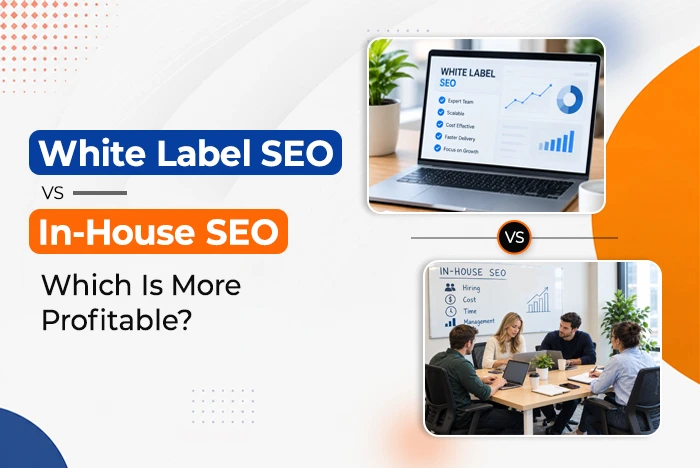
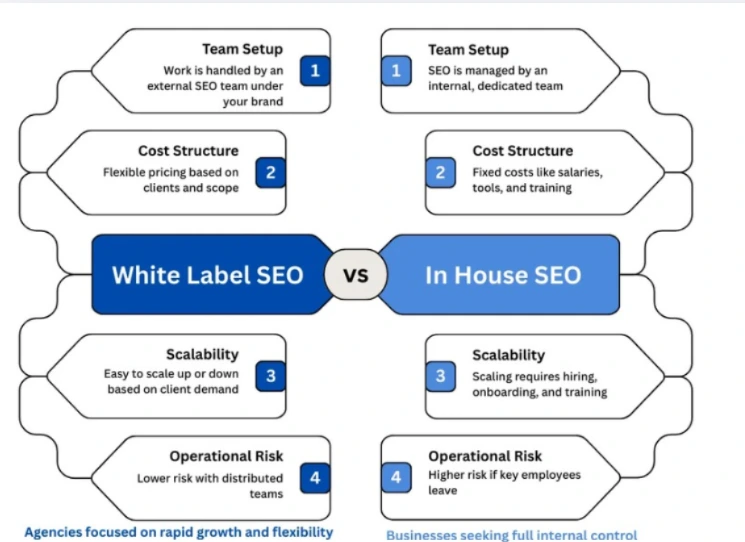
White Label SEO vs In-House SEO: Quick Comparison
| Factor | White Label SEO | In-House SEO |
| Setup time | Days | Weeks to months |
| Monthly cost | Pay per project or retainer | Salaries, tools, training |
| Control | Shared with partner | Full control |
| Scaling | Fast, add projects anytime | Slower, needs new hires |
| Best for | Agencies without SEO staff | Agencies with steady SEO demand |
Where the Profit Difference Really Shows Up
While it is true that the profit per client is greater when you perform the SEO work yourself, this profit is not as liquid as that from white label SEO. You only get to bill your client for the work that your SEO staff completes, as opposed to what you pay for the white label SEO service for that work.
In-house SEO teams have the same overhead of pay, whether an agency has 5 SEO clients or 15. The white label model provides an ideal transition to in-house, as most agencies start with white-label SEO services first, and then transition to in-house SEO as the number of SEO clients and corresponding revenue grows.
When In-House SEO Makes Sense?
Typically, when an agency has 10+ SEO customers paid on a monthly retainer, hiring in-house SEO is cheaper on a per-customer basis than working with a white-label SEO provider. Of course, there is also the value of having your own team of SEO experts who can speak in your brand voice and provide reports exactly as you need them.
In-house SEO is also highly recommended when clients require same-day changes, when they operate in a strict or regulated environment, or when they’re simply willing to pay a premium for in-housework.
Often, the work may look similar to white label SEO work, yet agencies charge a premium for the reassurance of in-house experts.
Risks to Watch Out for With Outsourced SEO
Remember, outsourcing is not risk-free. When your outsourced work is below par, it’s your agency name that your client sees, not that of your partner. A poor audit, thin content, or late delivery will harm your reputation first.
Carefully select a partner. Request sample reports. Test how they handle questions from your clients. Make sure someone reviews the work before it is published under your company name. A short test project for a few days before entering into a long-term agreement will uncover most problems early on. The loss of a client due to one wrong delivery is far more costly than a short test project.
How Advanced SEO Services Fit into the Picture?
And while white label search engine optimisation or in-house SEO work is being carried out, the fundamental work being undertaken by agencies for their clients has changed too. Basic keyword work and link placement to attempt to manipulate search engine rankings for client websites, for example, are not going to work anymore as they would have in years past.
A quality white label search engine optimisation partner will typically have all of this already covered in their processes & reporting software, enabling you to scale quickly and efficiently. The cost of replicating this expertise in-house, with relevant software, licenses, and ongoing training, is typically outside the budgets of most small in-house SEO teams until they have reached enough clients.
How to Choose the Right Model?
Before you decide, ask yourself these questions:
- How many SEO clients do you currently manage each month?
- Will your cash flow allow for the payment of fixed salaries during slow months?
- Will your clients require daily interaction with your team members?
- Is your current partner reporting as clear as your own, and can you pass it off as your own?
- Would a hybrid setup of in-house strategy and white-label execution work better for you?
There is no one-size-fits-all answer. A small agency with a handful of clients is likely to perform best with a partner, whereas a medium-sized agency with dozens of active SEO campaigns might save more by building its own team over time. But don’t make this decision once and then forget about it – reassess this each year, as your client base and cash flow will not remain constant.
Is White Label SEO for Agencies a Long-Term Fit?
Most agencies view SEO outsourcing as a short-term solution until they can employ their own SEO staff. However, outsourcing SEO as white labels for agencies has matured to become a viable long-term operating model for agencies of all sizes.
A number of big agencies buy white label SEO from outside teams they trust. It would be possible for many of them to hire internally and run it all in-house. Even so, most keep the partner route. The main reason is that the setup can grow with their volume. Also, the money they would save by changing providers is not that big.
Final Thoughts
There is no winner in the comparison between white label SEO and in-house SEO. Small to medium-sized agencies with unclear peak loads usually earn more by working with a white label partner. Larger agencies with high constant volumes of SEO work for their clients can earn better margins by working in-house over time.