Key Takeaways
- E-E-A-T overweights all other ranking signals for the area of financial services / fintech, since Google classifies financial content as “Your Money or Your Life” content.
- Backlinks for SEO fintech are still relevant, but a few high-quality links from trusted finance websites will generally always beat hundreds of low-quality links from irrelevant directories.
- Any good SEO agency will tell you that poor-quality content can never be salvaged by adequate quantities of linkages, and that depth is what converts surfers to leads.
Introduction
Most SEO experts would tell you that backlinks or great content are most important to reach the top of the fintech search results. But most of them would start with E-E-A-T, if they started with something at all. The reason Google treats financial content differently than a recipe or a travel guide is that bad information in finance can cost people real money. So, before we even get to talk about backlinks or great content, fintech brands first need to get E-E-A-T right.
What Is E-E-A-T, and Why Does Fintech Get Judged Harder?
The term E-E-A-T stands for Experience, Expertise, Authoritativeness, and Trustworthiness. This is the framework Google uses to rank sites based on how appropriate and valuable the information on said site is. For things that could potentially cause harm if they are incorrect (money, health, etc.) then even very high-quality pages will fail if they do not meet Google’s E-E-A-T criteria for ranking.
For fintech information, such as advice about short-term loans or how to choose a crypto wallet, content providers are sandwiched in the middle of this very high-ranking signal. Google will typically evaluate how much experience the author of a piece of financial content has, how much expertise they have, how authorities on the content provider’s website is, and how trustworthy the content itself is.

Much like a journalist’s byline at the bottom of a news article, the name of the author of a piece of content online is, essentially, the minimum necessary for search engine ranking purposes. As has been said before, much more than that is required, but no number of backlinks or volume of content will override failure with respect to E-E-A-T.
E-E-A-T is explicitly mentioned186 times in Google’s 176-page Search Quality Rater Guidelines, compared to Expertise being mentioned 104 times and Authority only 44 times. So, E-E-A-T clearly matters most for Google’s ranking evaluation of trust.
What Backlinks Actually Do for Fintech Sites?
The value of backlinks to influence ranking positions for a fintech website is huge for search engine marketing agencies promoting their services on their website. Because finance is an area where authority can easily be proven or disproven, a link from a quality resource (i.e. regulator, quality publication or industry-focused resource) can result in the biggest earliest gains for a website.
A link from a government funded website, a reputable publication, or industry blog carries far greater weight to a fintech website than fifty links to irrelevant directories. Quality over quantity is a mantra often used by search engine optimization experts but is particularly relevant for finance related content.
Even though backlinks are considered to have significance in terms of SEO for a fintech website, links alone won’t save poorly written content which is light on E-E-A-T. As far as Google is concerned and also from a user’s point of view a richly linked homepage with low quality ‘content’ remains desperately poor.
What “Good Content” Really Means for Fintech SEO?
Good content means providing the best possible answer to what a user searched for in as short and sweet of wording possible and without fluff. For a Seo for fintech campaign this typically means explaining advanced finance topics like how to calculate APRs or explaining various financial compliance requirements and fees charged by financial services in simple language.
Using very short paragraphs of content is also key. Rather than trying to cram lots of very detailed information into a single page, cover the whole topic, not half of it. A page about switching business bank accounts for example, would need to cover how to transfer direct debits as well as other features and benefits.
Author information, such as a named author with financial credentials, as well as information about the most recent update to a page, is more important in the fintech market than in almost any other market. Such information allows search engines, as well as readers, to assess whether content is up to date and credible.
So Which One Actually Matters Most?
For Fintech SEO, E-E-A-T comes first. If the E-E-A-T criteria are not met, then Google will not even consider the quantity of backlinks or the great content on the page. Inkfish SEO found that pages with weak E-E-A-T received virtually no organic traffic.
Content is next and provides the substance and value to keep users engaged and motivate other webmasters to link to your content. As backlinks provide amplification to already successful pages, things that work well are amplified.
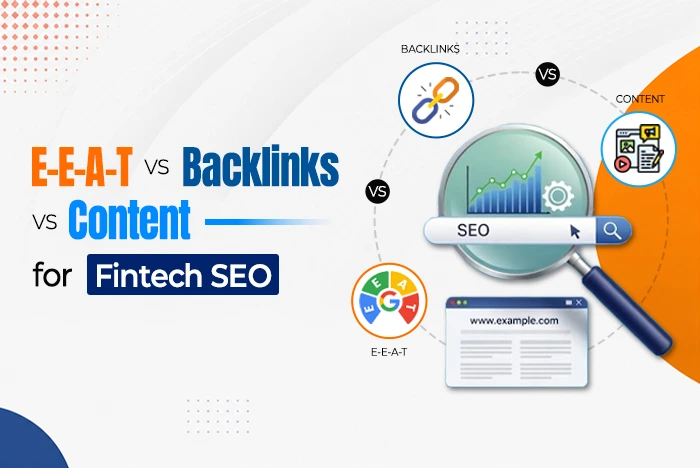
E-E-A-T earns you the right to rank; content earns you the click, and backlinks help you to rank faster once you are doing well on the first two points. Working on all three points simultaneously can be counterproductive and leads to all of them having to work even harder than they would have otherwise.
How a Fintech SEO Agency Typically Approach These Three Factors?
The teams behind the best fintech SEO agency work first complete an E-E-A-T audit of existing content on their website. This checks out basic criteria such as whether authors are named on content, whether there is a reviewer for highly regulated topics, and whether they can show any relevant credentials on the site. This is often the cheapest thing to change with the biggest impact.
Content follows E-E-A-T. So existing copy on your website will need to be drastically rewritten to add sufficient depth and make adequate sense. Subsequent copy will be written with the depth criteria in mind. Only once we have an adequate volume of suitable content will we begin to look at link building and where to send a link building campaign in order to get the maximum number of high-quality links in finance and business publications (and not generic sites).
It’s best to work with organic SEO services. This way you can avoid wasting your link building budget. Most other types of digital marketing such as PPC marketing and paid advertising will get you quick results but with search engine optimization for fintech and other niche markets the more difficult and time-consuming job of setting up solid content and linking has to come first.
Common Fintech SEO Mistakes to Avoid
Many established Fintech companies also regularly misstep on their Fintech SEO.
- Treat SEO for fintech as a separate niche. Content in the fintech industry requires more sources, more author transparency and more reviews than in most industries.
- Omitting additional reviews because content “looks good” in order for pages to lose visibility over time.
- Most organic SEO services packages were created for e-commerce or lifestyle companies and thus do not include YMYL (Your Money Your Life) requirements, review considerations and compliance-safe phrasing needed for financial content.
- Using a generic organic SEO services package. If the services are designed for e-commerce or lifestyle brands, then chances are the package will never even touch upon the reviewer requirements and compliance-safe phrasing for financial content that YMYL pages need.
- Do not use search engine marketing services from a search engine marketing agency to jump up in the rankings faster than the underlying trust has been built for generic/silently written content.
Addressing these issues in order will generally add more value to your fintech visibility efforts than almost any new technique.
The Bottom Line
Remember, E-E-A-T, backlinks and content are a sequence. First, set up the trust signals correctly. Then build content to fully answer a question. And in the end let the backlinks fall into place and improve what already works. Most fintech brands fail to properly implement a content strategy and then rebuild it as soon as they start link building. So just do it the right way from the start.