These days, SEO is more than just terms and backlinks. These advancements will make search systems better and more like people by 2026. People are using Google’s AI Overviews and creative outcomes more. There are new ways for businesses to improve their websites because of these developments. Relying solely on outdated methods is insufficient to maintain a competitive edge.
When this change happened, ai seo services requirements grew rapidly. Most importantly, everyone wants their sites to rank higher in AI search results. Artificial intelligence (AI) can guess what people will look for and what they want. This helps businesses make better, more focused SEO plans.
This article will discuss 9 effective ways to use AI in your SEO to enhance your content, achieve better results, and strengthen your online profile in a world where AI dominates search.
Why is AI Transforming SEO in 2026?
Smart computers are changing how search engines understand, process, and show results in many ways. Nowadays, search engines look at many things besides just the newest words. Additionally, they watch what people say and do and how it all connects. Not only does SEO improve the way websites work, but it also creates data that computers can understand and use.
A lot has changed since AI started to make search results. Individuals can get the information they need from these outcomes without having to click on numerous links. Showing AI search results is more important than showing normal results. If your content isn’t AI-friendly, people may not visit your site, even if it ranks first.
AI is also building up data and speeding up SEO. AI SEO services help businesses automatically find themes, research the industry, make content better, and guess how performance will change over time. This technology makes things go faster for marketing, so they can plan instead of writing things down by hand and finish things faster.
Additionally, localization and personalization are growing crucial; this is a major factor. Whatever Google sees fits the person’s location, tastes, and actions. That is why local SEO is important for businesses that want to reach people in their area.
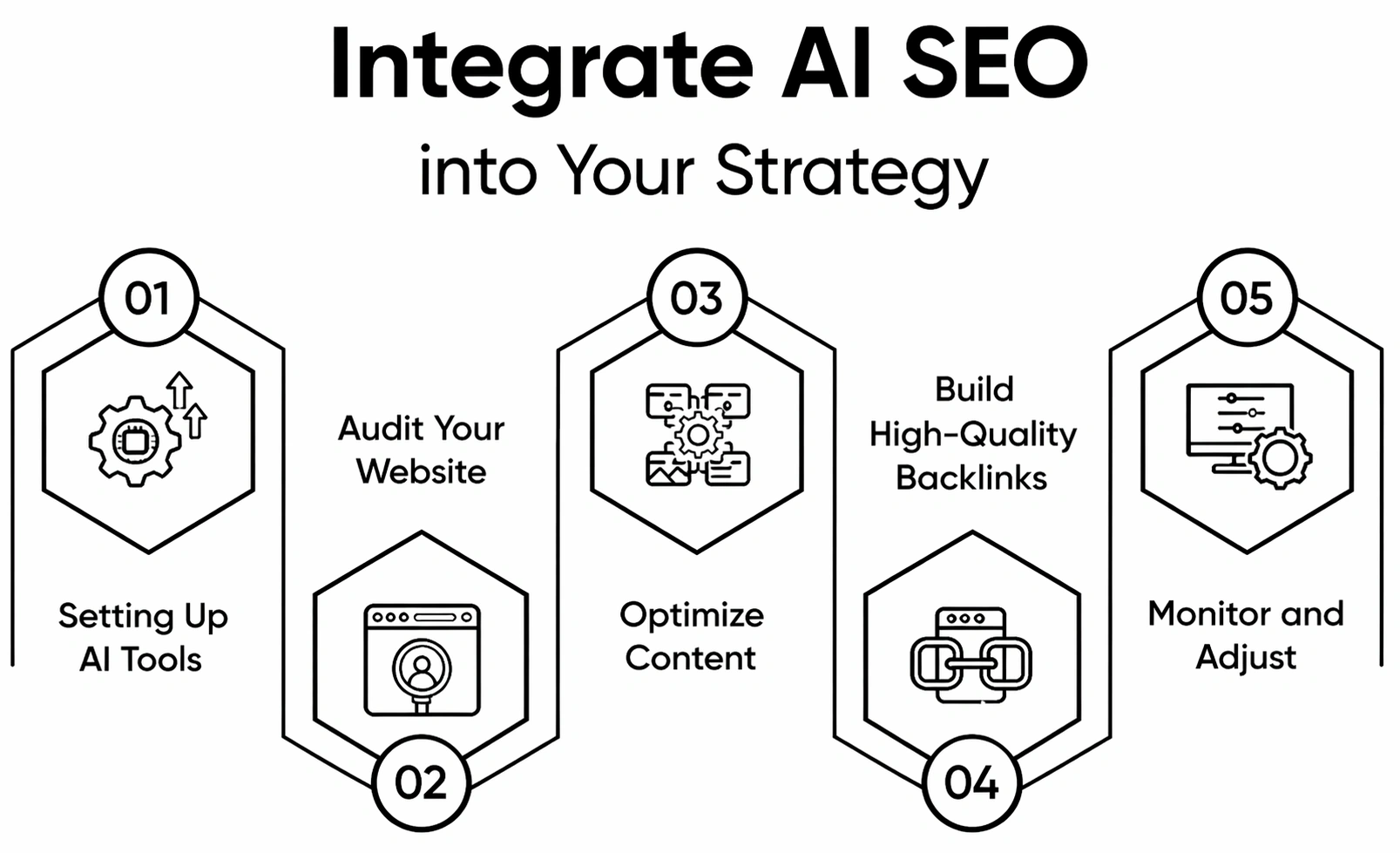
Ways to Use AI in Your SEO Strategies
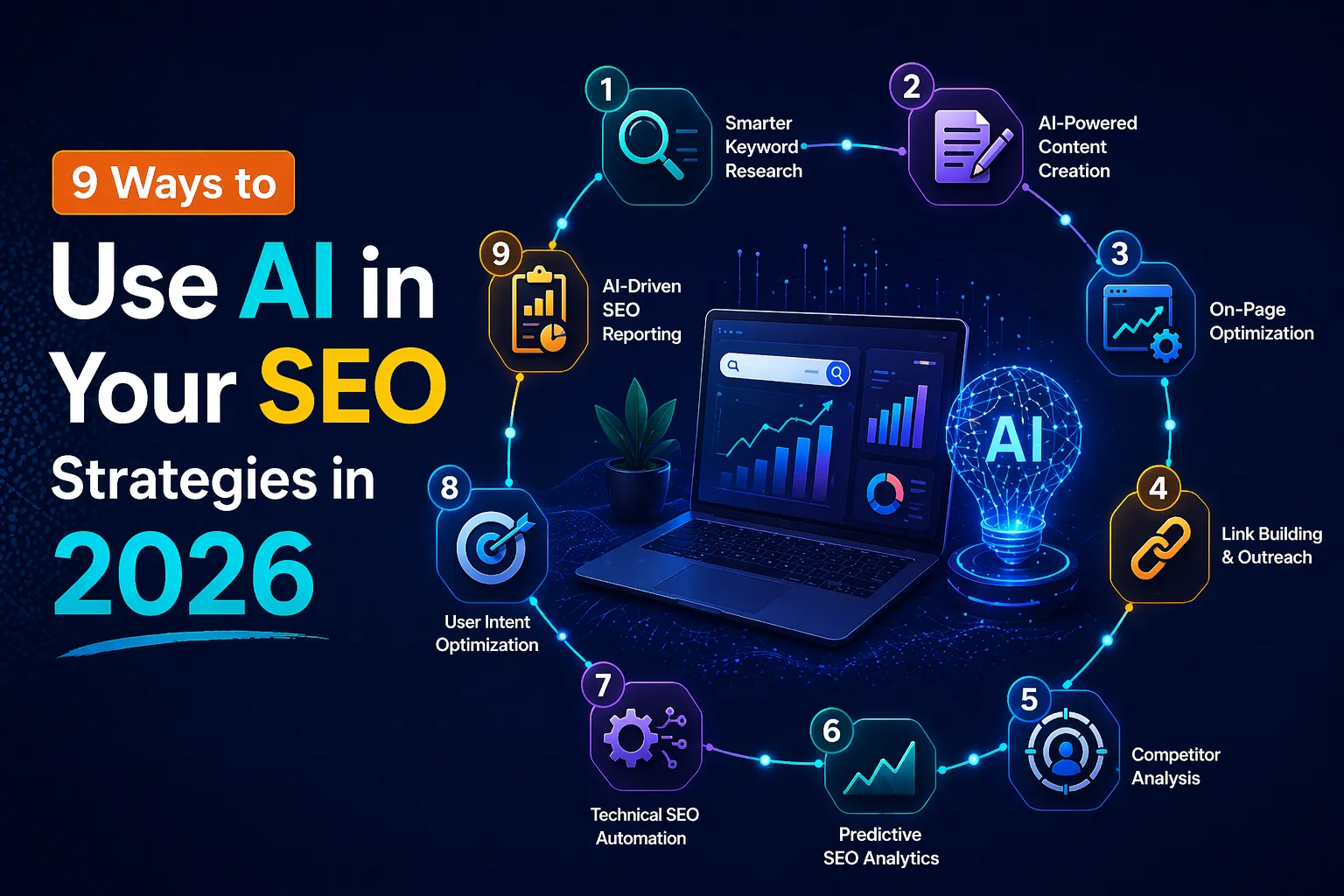
You can use AI in 9 different ways to improve your SEO:
1. AI-Powered Keyword Research
AI has changed keyword research from something that was done by hand and relied on guesswork to something that is based on data. AI tools look at search patterns, user behavior, and new trends to find opportunities that are more likely to convert, instead of just focusing on keywords that get a lot of traffic.
This helps companies find long-tail and intent-driven keywords that other tools might miss. A lot of modern AI SEO services use AI to group keywords together, guess what people will search for in the future, and put topics at the top of the list based on business goals.
2. AI for Search Intent Analysis
Not only is it important to know what people search for, but also why they search. By looking at query context, behavior signals, and content performance, AI helps figure out what people are looking for.
This lets companies make content that exactly meets the needs of users, whether they want information, to make a purchase, or to find local information. Websites can improve engagement, lower bounce rates, and boost conversions by making content more in line with intent. This makes SEO strategies more effective and targeted.
3. Content Creation & Optimization with AI
AI is now widely used to speed up the process of writing content, from making outlines to improving structure and readability. In addition to finding gaps in existing content, it suggests ways to make it better and makes sure that it matches what people are searching for.
But what really matters is combining the speed and accuracy of AI with people’s knowledge and experience to make sure that things stay original and reliable. Utilizing AI search optimization services, businesses can create more content while keeping the quality and relevance high.
4. AI for Technical SEO Audits
Technical SEO can be hard to understand, but AI makes it easier by finding problems that hurt performance automatically. An AI tool can quickly look over a website and point out problems like crawl errors, broken links, slow pages, and issues with indexing and crawling.
This helps companies fix problems faster and keep their websites technically sound, which is important for user experience and search engine rankings.
5. AI-Driven On-Page SEO Optimization
AI helps improve on-page elements by looking at pages that rank highly and figuring out what works best. It can tell you how to make headings, meta descriptions, keyword placement, and internal links better.
These insights ensure that search engines can easily comprehend the content organization. This makes it more relevant and increases its chances of ranking without having to use trial-and-error methods.
6. Enhancing Visibility in AI Search
With the rise of AI-generated results, one of the main goals of SEO strategies is now to make websites more visible in AI search. Artificial intelligence (AI) organizes content to increase its chances of inclusion in AI summaries, snippets, and answer boxes.
To do this, you need to use structured data, clear headings, and content that makes sense. Companies that do their best to get AI-driven results can get people’s attention before they even click through to their website.
7. AI for Local SEO & GEO SEO
AI is very important for improving local search results because it looks at how people search based on their location and adjusts content accordingly.
Strategies like GEO SEO and generative engine optimization help businesses target specific regions, making it easier to appear in local search results and map listings. help businesses target specific regions, making it easier to appear in local search results and map listings.
AI can also help optimize Google Business Profiles, take care of local citations, and find location-specific keywords that bring in high-intent visitors.
8. AI for Competitor Analysis
AI tools can look at huge amounts of data in seconds, which speeds up and improves competitor analysis.
Companies can find out what keywords their competitors are ranking for, what content works best, and where there are gaps.
This helps you come up with better strategies and find ways to do better in search rankings than your competitors.
9. AI for Performance Tracking & Predictive SEO
AI lets you track performance in real time and even predicts what will happen in the future. Businesses can make smart decisions by looking at past data to predict things like traffic, keyword rankings, and user behavior.
This move toward predictive SEO lets marketers stay ahead of changes instead of reacting after performance drops. This makes SEO strategies more effective and ready for the future.
How to Choose the Right AI SEO Services?
AI can give your ideas and insights, but it can’t fully take the place of long-term SEO planning and strategy. AI can give your ideas and insights, but it can’t fully take the place of long-term SEO planning and strategy.
- Strategy + AI Balance: Choose a provider that combines AI capabilities with human expertise. The best results come from blending automation with strategic thinking, not relying on AI alone.
- Customised Approach: Avoid one-size-fits-all solutions. The right AI search optimization services should tailor strategies based on your industry, goals, and competition.
- Focus on Results, Not Just Tools: Many agencies use AI tools, but what matters is how they translate insights into rankings, traffic, and leads. Look for a strong focus on outcomes.
- Experience with AI SEO: Ensure the agency has proven experience in delivering ai seo services, including case studies or measurable results.
- Content Quality Standards: Check how they handle AI-generated content. A reliable agency will prioritise originality, E-E-A-T, and human editing to maintain quality.
- Technical SEO Capabilities: AI should be used to improve site performance, crawlability, and indexing. Make sure the agency has strong technical expertise.
- Transparency & Reporting: The agency should provide clear insights into performance, including rankings, traffic, and improvements in visibility in AI search.
- Scalability & Flexibility: As your business grows, your SEO strategy should scale. Choose a provider that can adapt and expand your campaigns over time.
Conclusion
AI is reshaping SEO in ways that go far beyond automation. From smarter keyword research to predictive insights and improved visibility in AI search, it is helping businesses build more efficient, data-driven strategies. However, the real advantage comes from how AI is used, not just the tools themselves.
The most successful SEO strategies in 2026 will combine the power of ai seo services with human expertise, ensuring content remains relevant, original, and aligned with user intent.
Businesses that adapt to this shift and invest in the right AI search optimization services will be better positioned to stay competitive, attract high-quality traffic, and drive consistent growth.