Key Takeaways
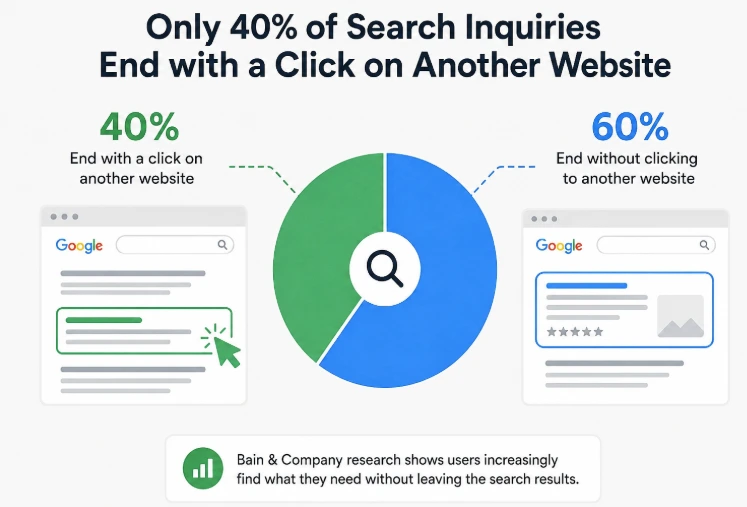
- Only 40% of searches now end with a click to another website (Bain & Company) so if your brand isn’t named inside the AI’s answer, most users will never see it.
- The same Bain & Company research found that 42% of chatbot users ask directly for shopping or product recommendations. This is when a brand gets picked or passed by.
- Getting recommended by ChatGPT is based on your brand being clearly defined, having up-to-date information on your brand, and your brand being mentioned on trusted third-party sites, not just your brand’s website.
Introduction
Searching is changing. The reason is that customers are not only clicking Google results anymore; they’re going to AI tools and asking for a recommendation. This means that brands that get listed in these responses will have a strong advantage.
The responses to users’ questions are delivered right within the chat window and not off on another website. Thus, it is even more crucial for businesses to get their brand AI SEO up to scratch in order to be picked by the search over their competition. This guide will take you through how AI SEO services can work in an easy way.
What Is AI SEO?
AI SEO refers to engineering content within AI tools like ChatGPT, Gemini, and Perplexity so that it can be found, read, and quoted within the generated output. While “classic” SEO is focused on ranking pages on Google’s results pages (and now within results pages above), AI SEO is practiced in conjunction with that end goal, i.e., as an SEO agency, you would work AI SEO in much the same way as you would work SEO for traditional web results pages.
For example, to land your brand on page one of Google’s results pages, but now in addition to that, you would also work to get your brand mentioned within the answer itself that appears above traditional results pages, above the fold within results pages.
How ChatGPT Decides Which Brands to Recommend
ChatGPT does not have a live index of the entire web as Google does. The generative AI model relies on the data it was trained on, plus the web search function that is built into the chatbot itself. The chatbot can also be configured to incorporate third-party data from review sites, forums, and news.
Therefore, the brand needs to have mentioned with clear facts and reviews on other web pages – not just the brand’s own website. That is where the generative engine optimization services can come in to ensure that a brand’s facts, reviews, and areas of expertise are presented on the web in a format that chatbots can use.
SEO vs AEO vs GEO: What’s the Difference
These three terms are often misused, but we can provide you with a quick overview so you can learn more.
- SEO (search engine optimization) which ranks pages in Google’s organic results.
- AEO (answer engine optimization) – We help your brand rank in the direct answer box on Google (or other search engines), voice assistant answers (e.g., Siri, Google Assistant), or feature snippets on Google search results. Other types of answers in search results also fall into this category.
- GEO, or Generative Engine Optimization: Gets your Brand cited or summarized within the written chatbot answer (AEO) and thus can be successfully offered as generative engine optimization services.
All three elements are crucial to optimization efforts; therefore, AEO answer engine optimization services are typically bundled with AI SEO services to form one comprehensive SEO project for clients.
How to Get Your Brand Recommended by ChatGPT?
A few things consistently move the needle:
- On each page, write a direct one-sentence answer to all of the questions on said page, then elaborate on each sentence fully on said page.
- Define key terms in plain language: “X is Y that does Z” Get your brand mentioned on as many quality independent sites as possible. This could be in the form of reviews, comparison articles, forum postings, or even industry publications relevant to your target market.
- The latest information on the facts and pricing of your brand, as AI models can very quickly drop a brand that appears to be out of date.
- Add schema markup to all your web pages and clean up any existing, erroneous structured data.
- Try to make your pages sort of snippet worthy by using straightforward headings, short answers, and content that stays nicely structured. After that, take your top-performing pages and do Answer Engine Optimization, or AEO, so AI tools can locate your stuff a lot easier and then actually recommend it.
It is worth noting that all of this work is intended to be able to support strong writing, not to replace it. By making content more easily liftable and more trustworthy, one can ensure that the models are able to find and use it easily.
How does e intelligence help brands show up in AI Answers?
The report line item for “brand mentions in AI answers” is a standard we have implemented for our work with clients in the fitness space, home services, and SaaS as well as other verticals. Similar to the tracking of organic traffic in search, we start by completing an SEO audit to see how a brand’s content surfaces in the AI answers generated by ChatGPT, Perplexity, and the Google AI Overviews.
Our aeo answer engine optimization services modify existing information to make it directly citable. We also provide generative engine optimization (seo) services that build off existing information in a model’s generative output that contains mentions of third-party information. Additionally, we can provide the necessary schema and other technical cleanup for your website so that the search engines can properly read the information on the pages.