
ChatGPT has changed how businesses approach digital marketing by helping teams research topics, create content, analyze information, and communicate with customers more efficiently. When used strategically, this AI tool can support marketing teams in saving time, developing ideas, and improving customer experiences.
However, ChatGPT is not a replacement for human expertise, reliable data, or a well-planned marketing strategy. The best results come from combining AI capabilities with human creativity, fact-checking, and a clear understanding of customer needs.
In this guide, we explore how ChatGPT can support digital marketing, its key applications, practical ways to use it, and the limitations businesses should consider.
What Is ChatGPT?
ChatGPT is an AI assistant developed by OpenAI that can understand prompts and generate responses in natural language. It can assist with tasks such as brainstorming, summarizing information, drafting content, analyzing supplied data, writing code, and organizing ideas.
For digital marketers, ChatGPT can act as a support tool throughout the marketing process. For example, it can help generate blog topic ideas, draft social media captions, suggest email subject lines, prepare customer support responses, and organize campaign concepts.
Its output depends on the instructions, context, and information provided. It can also make mistakes, misunderstand a request, or produce outdated or inaccurate information. Therefore, marketers should review important outputs before publishing or using them to make business decisions.
Businesses exploring AI-driven campaigns can learn more about ChatGPT marketing services from e intelligence.
How Generative AI Is Changing Digital Marketing
Generative AI is helping marketing teams handle repetitive tasks and explore new ideas more efficiently. It can support content development, customer communication, research, and campaign planning.
Here are some of the key changes it brings to digital marketing:
- Faster content development: Marketers can use AI to create initial drafts, outlines, headlines, and content variations.
- More relevant messaging: With appropriate, non-sensitive audience insights, AI can help adapt messages to different customer segments.
- Improved research workflows: AI can organize supplied information, summarize research, and identify questions that deserve further investigation.
- Campaign support: Marketers can develop alternative ad copy, email subject lines, and calls to action for testing.
- Customer service assistance: AI-powered chatbots can help answer common questions and direct customers to relevant resources.
- Better workflow efficiency: Teams can use AI to create first drafts, summarize meetings, and organize marketing tasks.
AI does not automatically improve campaign performance. Results still depend on the quality of the strategy, the accuracy of the information, the customer experience, and ongoing performance analysis.
Businesses should also establish clear rules for data privacy, brand voice, human approval, and responsible AI use.
How ChatGPT Can Improve Your Digital Marketing Strategy
ChatGPT can support different stages of a digital marketing strategy, from initial research to content production and campaign optimization. The key is to give it a specific task and review its output against real business goals.
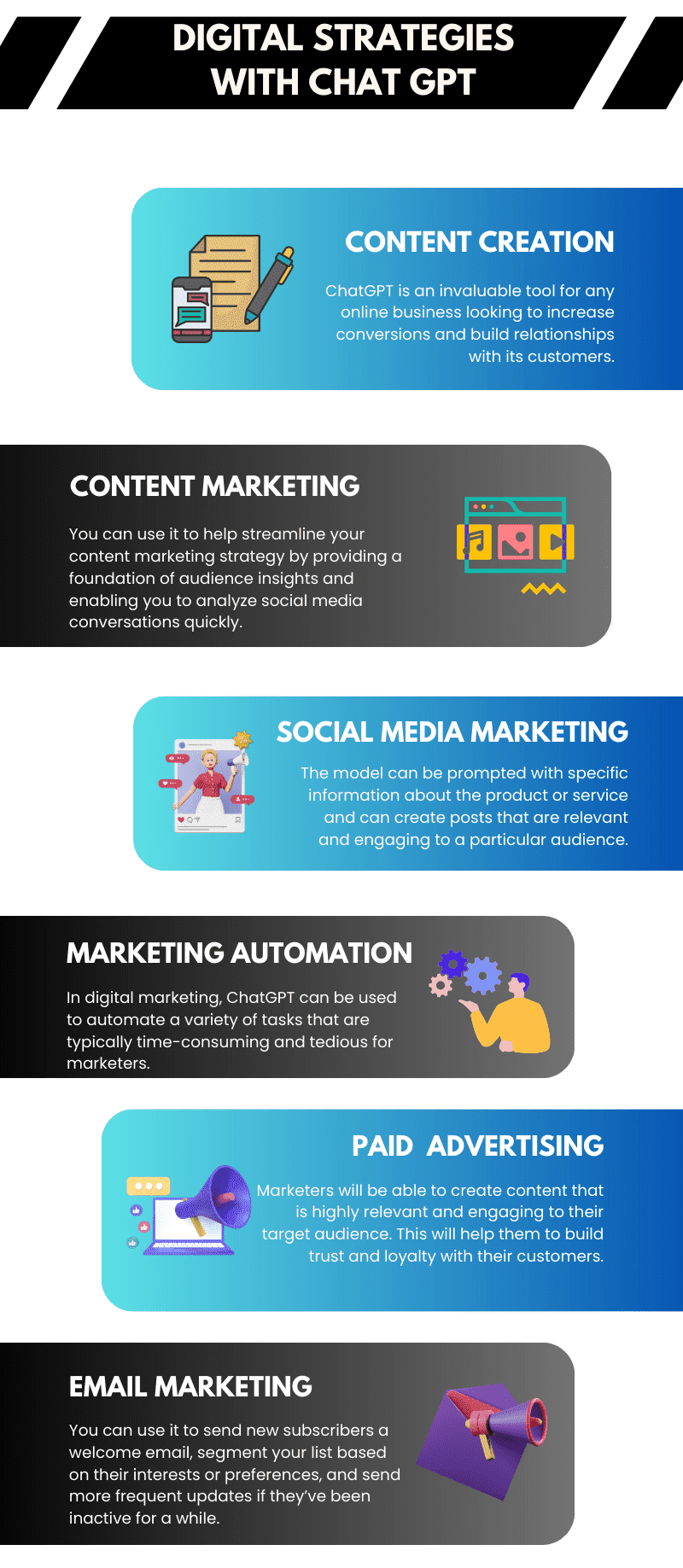
<figure> <img src=”https://eintelligenceweb.com/wp-content/uploads/2023/04/Digital-Strategy-with-ChatGPT-1.png” alt=”Using ChatGPT to support digital marketing strategy planning” /> </figure>
Here are some practical ways to use ChatGPT in your marketing workflow.
1. Content Creation and Optimization
Content creation is one of the most common uses of ChatGPT in digital marketing. It can help marketers brainstorm ideas, build outlines, draft sections, rewrite complex explanations, and adapt content for different audiences.
For example, a marketer can use ChatGPT to:
- Generate blog topic ideas based on customer questions.
- Create outlines for service pages and blog posts.
- Draft product descriptions, FAQs, and landing page copy.
- Suggest alternative headlines and calls to action.
- Review content for readability, clarity, and consistency.
- Create initial meta title and meta description options.
ChatGPT can also support SEO content planning by organizing keyword research and suggesting ways to address search intent.
However, AI-generated content should not be published without review. Check facts, add original insights, include relevant examples, and make sure the final content reflects your brand’s expertise.
Google’s guidance focuses on helpful, reliable, people-first content. Using AI is not automatically against Google’s guidelines, but generating large amounts of low-value content primarily to manipulate search rankings can violate its spam policies. Read Google’s guidance on generative AI content.
2. Content Marketing
A successful content marketing strategy requires understanding your audience, choosing useful topics, and publishing content that answers real questions. ChatGPT can help organize these activities and reduce the time spent on repetitive planning tasks.
Marketers can use it to:
- Brainstorm content ideas based on customer pain points.
- Develop editorial calendars and content briefs.
- Turn a long article into a newsletter or social media post.
- Suggest FAQs based on a topic or supplied customer feedback.
- Create different versions of a message for different channels.
- Summarize research that the team can verify using reliable sources.
For example, a digital marketing agency could use ChatGPT to develop an initial outline for a guide about local SEO. A subject-matter expert can then add practical recommendations, real examples, original analysis, and verified information.
This approach combines the speed of AI with the experience and judgment of human marketers.
3. Social Media Marketing
Social media marketing requires regular communication, creative ideas, and content tailored to each platform. ChatGPT can help teams plan and draft social media content while maintaining a consistent brand voice.
Possible applications include:
- Creating initial captions for social media posts.
- Suggesting campaign themes and content calendars.
- Drafting responses to common customer questions.
- Repurposing blog content into short posts.
- Generating alternative calls to action.
- Brainstorming ideas for polls, short videos, and educational posts.
For example, a business launching a new service could ask ChatGPT to create several caption options for different audience segments. The social media team can then refine the wording to suit the platform and brand.
AI should support genuine communication rather than replace it. Review responses carefully, especially when customers raise complaints, discuss sensitive issues, or require account-specific assistance.
Explore social media marketing services to learn how social media can fit into a broader digital marketing strategy.
4. Marketing Automation
Marketing automation helps businesses manage repetitive communication and campaign tasks. ChatGPT can support automation workflows by drafting messages, organizing content, and generating response templates.
Examples include:
- Drafting welcome emails for new subscribers.
- Creating follow-up message variations.
- Preparing templates for frequently asked questions.
- Suggesting customer journey stages and communication ideas.
- Writing draft responses for support teams.
- Helping document campaign processes and workflows.
When connected to suitable tools and systems, AI may also assist with parts of a larger workflow. However, integrations, permissions, testing, and monitoring are necessary before automation is used with real customers.
Not every task should be automated. Important complaints, billing issues, sensitive requests, and complex customer questions may require a human representative.
The goal is to reduce repetitive work while keeping customer communication accurate, relevant, and helpful.
5. Paid Advertising
ChatGPT can help advertising teams develop and refine campaign messaging. It can generate alternative ad headlines, descriptions, calls to action, and creative concepts based on a product, audience, or campaign objective.
Marketers can use it to:
- Draft multiple versions of ad copy.
- Suggest messages for different customer segments.
- Brainstorm value propositions and campaign themes.
- Create initial landing page copy.
- Develop hypotheses for A/B testing.
- Review supplied campaign results and organize possible next steps.
For example, a business promoting a web development service could test messages focused on website performance, usability, or lead generation. ChatGPT can help develop the variations, while actual campaign data determines which messages perform better.
AI-generated copy does not guarantee higher click-through rates or conversions. Marketers should test their messaging, monitor campaign performance, and ensure all advertising claims are accurate.
6. Email Marketing
Email marketing allows businesses to build relationships with subscribers and guide customers through different stages of the buying journey. ChatGPT can help teams draft emails and adapt messaging to different campaign goals.
Common uses include:
- Writing newsletter drafts.
- Suggesting subject lines and preview text.
- Drafting welcome and onboarding emails.
- Creating abandoned-cart email variations for relevant businesses.
- Preparing re-engagement campaign ideas.
- Adjusting the tone of messages for different audiences.
For example, an eCommerce business could use ChatGPT to draft a welcome email that explains its products, delivery process, and customer support options. The marketing team should verify the details and ensure that subscribers receive only appropriate communications.
Personalization should be based on legitimate data use and applicable privacy requirements. Avoid placing confidential customer information into AI tools unless the tool and its settings are approved for that use.
Email performance should be measured using relevant metrics, such as clicks, conversions, unsubscribes, and revenue where applicable, rather than relying only on open rates.
7. Customer Support and Lead Generation
ChatGPT can help businesses improve customer communication by supporting chatbots, response templates, and lead qualification workflows.
Depending on the implementation, these solutions may help businesses:
- Answer common questions about products or services.
- Direct visitors to relevant website pages.
- Explain service options and basic processes.
- Collect initial enquiry details with appropriate consent.
- Route complex questions to the right team.
- Provide support outside standard business hours.
For example, a website chatbot could answer general questions about a company’s services and direct interested visitors to a contact form. A human team member can then handle specific requirements and qualified enquiries.
The quality of the experience depends on the information available to the chatbot, the design of its workflow, and the safeguards in place. Businesses should make it easy for customers to reach a human when needed.
Avoid making unsupported promises about products, prices, delivery times, or results. Monitor chatbot conversations and update its information when business details change.
8. Research and Marketing Analytics
ChatGPT can assist with marketing research by summarizing information, categorizing feedback, and helping teams interpret data they provide.
Useful applications include:
- Grouping customer feedback into common themes.
- Summarizing survey responses.
- Organizing competitor research collected from reliable sources.
- Suggesting questions for customer interviews.
- Explaining marketing metrics in simple language.
- Helping analyze supplied campaign data and identify patterns to investigate.
For example, a marketing team could provide an appropriately anonymized set of survey responses and ask ChatGPT to group recurring customer concerns. The team can use those themes to inform content ideas or improve its messaging.
However, ChatGPT should not be treated as a source of verified live market data by default. Validate important facts, check the original sources, and use analytics platforms for authoritative performance measurements.
Never assume that a pattern in a small dataset proves cause and effect. Use AI insights as a starting point for further analysis.
How to Use ChatGPT Effectively for Digital Marketing
The quality of ChatGPT’s output often depends on the quality of the prompt and context you provide. A clear prompt helps the tool understand the audience, task, format, and expected result.
Follow these best practices.
1. Define Your Marketing Goal
Start by identifying the result you want to achieve. For example, you may want to create a blog outline, improve an email, brainstorm social media content, or summarize campaign data.
A specific goal helps prevent vague or irrelevant responses.
2. Provide Relevant Context
Explain your business, target audience, service, brand voice, and the purpose of the content. Include reliable source material where necessary.
Avoid sharing confidential customer data, passwords, private business information, or other sensitive details unless the tool and use case are approved for that information.
3. Give Clear Instructions
Specify the format, tone, length, and requirements. If you need an SEO blog, provide the primary keyword, audience, search intent, and internal URLs that should be included naturally.
For example:
“Create a blog outline for a digital marketing agency targeting small businesses. Explain practical uses of ChatGPT in SEO and content marketing. Use clear headings, simple language, actionable examples, and a helpful, professional tone. Do not invent statistics or make guaranteed ranking claims.”
4. Verify Facts and Review the Output
Check statistics, dates, product details, links, technical advice, and other factual claims before using the response. Add expert input and original insights where necessary.
For SEO content, review whether the page answers the reader’s question, provides genuine value, and reflects your business’s experience.
5. Test and Improve
Use ChatGPT to create alternative headlines, ad copy, email subject lines, and content approaches. Test them using real audience and campaign data.
Keep what works, revise what does not, and avoid assuming that AI-generated recommendations will automatically improve performance.
6. Establish Responsible AI Guidelines
Create clear rules for who can use AI, what information can be entered, which outputs require approval, and how errors should be reported.
For business use, review the tool’s data handling and privacy settings before entering internal or customer information.
Limitations and Risks of Using ChatGPT in Marketing
Although ChatGPT can improve marketing workflows, it has limitations. Understanding these risks helps businesses use AI more responsibly.
- Incorrect information: ChatGPT can generate inaccurate facts, statistics, citations, or recommendations. Verify important claims before publication.
- Generic content: Outputs may lack originality, practical experience, or a distinctive brand voice unless carefully developed and edited.
- Privacy concerns: Entering confidential or personal information without appropriate safeguards can create data protection risks.
- Copyright and originality: AI-generated content should be reviewed for originality, rights-related concerns, and appropriate use of source material.
- Brand consistency: Automated responses may not always match the brand’s tone or understand the context of a customer conversation.
- Overdependence on automation: Excessive reliance on AI can reduce human oversight and lead to poor customer experiences.
- Uncertain marketing results: AI does not guarantee better rankings, higher engagement, or increased revenue.
A balanced approach combines AI efficiency with human review, original thinking, reliable evidence, and clear accountability.
ChatGPT and SEO: What Marketers Should Know
ChatGPT can support SEO tasks such as brainstorming keywords, planning content, drafting outlines, improving readability, and developing FAQ ideas. It can also help marketers understand SEO concepts and organize findings from technical audits.
However, AI-generated content is not automatically search-engine-friendly. Content still needs to satisfy user intent, provide accurate information, and offer value beyond what is already available online.
Google’s guidance for AI-powered search continues to emphasize established SEO practices, crawlable pages, and useful, distinctive content. There is no guaranteed shortcut to appearing in AI-generated answers.
To improve your website’s search visibility:
- Create original, useful content that addresses real customer needs.
- Keep important pages accessible to search engines.
- Maintain a clear website structure and relevant internal links.
- Check technical SEO issues and page experience.
- Support claims with reliable sources and demonstrable expertise.
- Monitor performance and update content when there is a genuine reason to do so.
Learn more about SEO services from e intelligence and explore generative engine optimization for additional information about evolving AI search experiences.
For further guidance, refer to Google’s official guide to optimizing for generative AI features in Search.
Frequently Asked Questions
Can ChatGPT be used for digital marketing?
Yes. ChatGPT can help with content planning, drafting, research, social media posts, email marketing, advertising ideas, and customer support workflows. Its output should be reviewed for accuracy, relevance, and brand consistency.
Can ChatGPT replace a digital marketing agency?
No. ChatGPT can support marketing tasks, but it does not replace strategic planning, technical implementation, creative judgment, customer knowledge, or accountability for business results. Marketing teams and agencies can use it as one tool within a broader strategy.
Is ChatGPT-generated content good for SEO?
It can be useful when the final content is accurate, helpful, original, and created for people. Publishing large amounts of low-value AI content primarily to manipulate search rankings can violate Google’s spam policies. Human review and meaningful added value remain important.
Can ChatGPT improve customer engagement?
It can help businesses respond to common questions, develop relevant messages, and support chatbot workflows. Actual engagement depends on the quality of the information, the customer experience, and how well the implementation meets users’ needs.
Is it safe to use ChatGPT with customer data?
That depends on the type of data, the product and settings being used, and your organization’s privacy and security requirements. Avoid entering sensitive or confidential information unless the specific use has been reviewed and approved.
Conclusion
ChatGPT is a useful tool for modern digital marketing when it is applied with a clear purpose. From content creation and social media marketing to paid advertising, email campaigns, customer support, and research, it can help teams work more efficiently and explore new ideas.
However, successful marketing requires more than AI-generated content. Businesses still need reliable information, customer insights, original ideas, technical expertise, and consistent performance measurement.
The best approach is to use ChatGPT to support human expertise, not replace it. By setting clear goals, checking outputs, protecting data, and testing results, businesses can make AI a practical part of their digital marketing strategy.
Take Your AI Marketing Strategy Further with e intelligence
e intelligence helps businesses explore digital marketing strategies, including SEO, paid campaigns, web development, and ChatGPT-related marketing solutions.
Whether you want to improve your content workflow, explore AI-assisted customer communication, or strengthen your online presence, a strategy built around your business goals can help you use technology more effectively.
Explore our ChatGPT marketing services or contact e intelligence to discuss your digital marketing objectives.